
Healthcare practices need more than excellent patient care to remain financially successful. They also need an efficient system for managing insurance claims, collecting payments, reducing billing errors, and maintaining a consistent cash flow. This is where medical billing and Revenue Cycle Management (RCM) become essential.
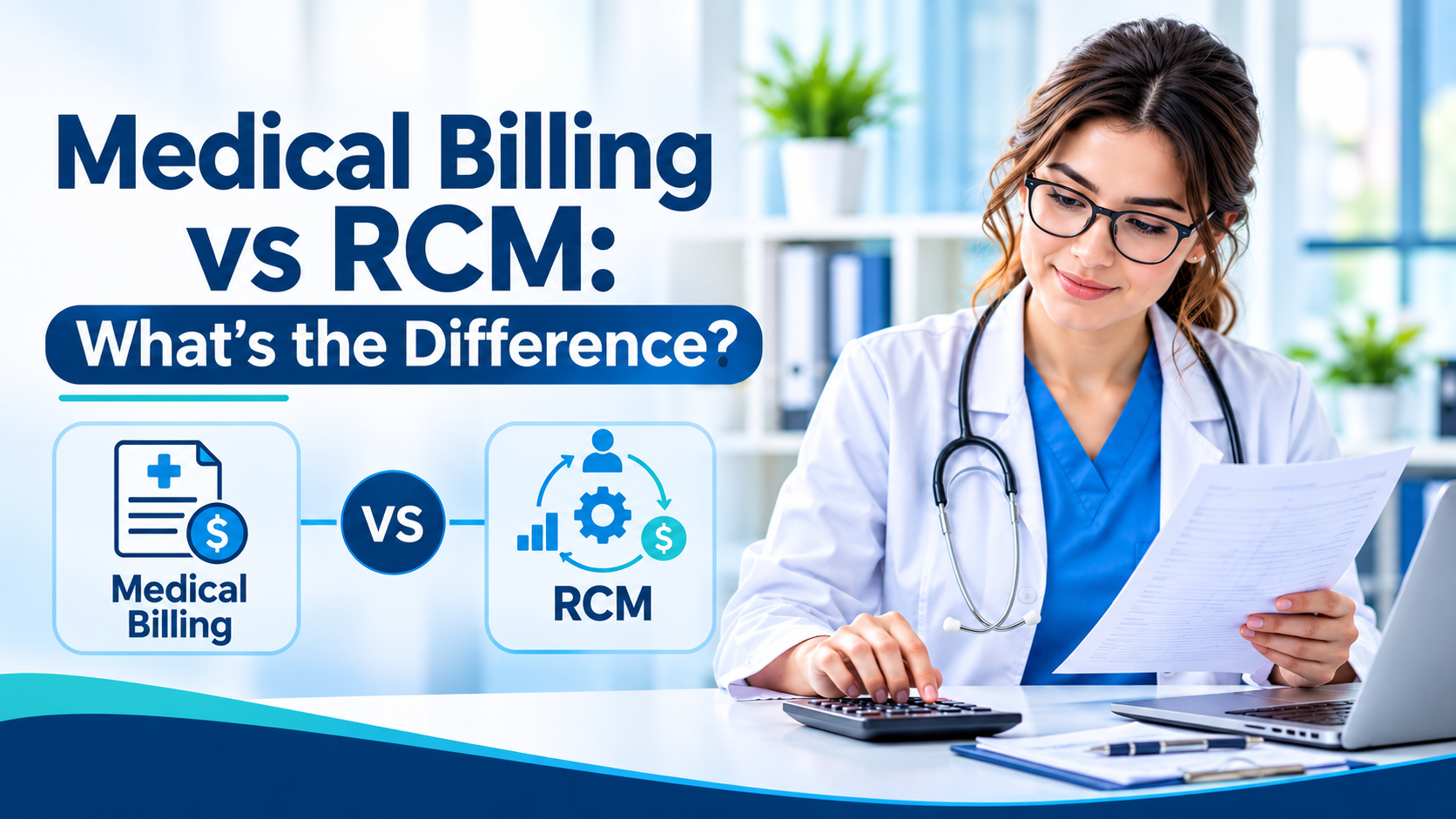
Although the terms medical billing and Revenue Cycle Management are frequently used interchangeably, they are not exactly the same. Medical billing primarily focuses on submitting claims and securing reimbursement for healthcare services, while RCM encompasses the entire financial process, beginning with patient registration and ending with the final payment.
Understanding the difference between medical billing and RCM can help healthcare providers identify operational gaps, improve revenue performance, and choose the right support for their practice.
What Is Medical Billing?
Medical billing is the process of converting healthcare services provided to patients into claims submitted to insurance companies or other responsible payers for reimbursement.
After a patient receives medical care, the billing team collects relevant information, prepares claims, submits them to insurance companies, and follows up to ensure payments are received correctly.
Medical billing plays a critical role in helping healthcare providers receive compensation for the services they deliver.
Key Responsibilities of Medical Billing
Medical billing generally includes:
- Preparing and submitting insurance claims.
- Entering charges for medical services.
- Reviewing claims for billing errors.
- Verifying insurance information and coverage details.
- Posting insurance payments and adjustments.
- Following up on outstanding claims.
- Identifying denied or rejected claims.
- Supporting denial resolution and appeals.
- Preparing patient statements.
- Managing outstanding patient balances.
Accurate medical billing helps prevent unnecessary claim rejections, reduces payment delays, and supports consistent reimbursement.
However, billing alone may not address every financial challenge a healthcare practice faces. Problems involving patient registration, insurance eligibility, authorization, documentation, or collection processes can affect reimbursement before or after a claim reaches the billing department.
What Is Revenue Cycle Management (RCM)?
Revenue Cycle Management, commonly known as RCM, is a comprehensive approach to managing the financial lifecycle of healthcare services.
RCM includes all administrative and financial activities required to generate, process, and collect revenue from patient care. It begins before a patient receives treatment and continues until the provider receives the appropriate payment and resolves outstanding balances.
According to the American Medical Association, effective RCM involves patient registration, insurance verification, clinical documentation, medical coding, billing, claims processing, denial management, and patient collections. AMA+1
Key Responsibilities of RCM
An effective RCM process typically includes:
- Patient registration and demographic information.
- Insurance eligibility and benefits verification.
- Prior authorization and referral management.
- Patient financial responsibility estimation.
- Clinical documentation and charge capture.
- Medical coding and billing.
- Claims submission and tracking.
- Payment posting and reconciliation.
- Denial management and appeals.
- Accounts receivable (A/R) follow-up.
- Patient billing and collections.
- Financial reporting and performance analysis.
RCM connects these activities into a coordinated workflow, helping healthcare organizations identify revenue gaps and improve financial performance.
Medical Billing vs RCM: Key Differences
The primary difference between medical billing and RCM is the scope of responsibilities. Medical billing focuses mainly on claims and reimbursement, whereas RCM manages the broader financial process surrounding patient care.
| Feature | Medical Billing | Revenue Cycle Management |
|---|---|---|
| Primary focus | Claims and reimbursement | Entire revenue lifecycle |
| Patient registration | May be included | Core responsibility |
| Insurance verification | Often included | Included |
| Medical coding | Commonly included | Included |
| Claims submission | Core responsibility | Included |
| Payment posting | Commonly included | Included |
| Denial management | Claim-focused | Comprehensive denial prevention and resolution |
| A/R management | Often limited to billing follow-up | Broader outstanding revenue management |
| Patient collections | May be included | Integrated into the revenue cycle |
| Financial reporting | Billing-related reports | Comprehensive financial performance analysis |
| Revenue optimization | Primarily claim-level | End-to-end revenue improvement |
The exact responsibilities can vary between vendors. Some medical billing companies provide extensive RCM services, while some RCM providers offer only selected components. Healthcare practices should evaluate the actual services included rather than relying exclusively on a company’s name. pgmbilling.com+1
1. Front-End Revenue Cycle
The front-end process begins before the patient receives medical services.
It includes:
- Patient scheduling and registration.
- Collecting demographic and insurance information.
- Verifying insurance eligibility.
- Checking benefits and coverage.
- Obtaining necessary prior authorizations.
- Communicating expected patient financial responsibility.
Errors during this stage can result in claim rejections, delayed payments, and additional administrative work.
2. Mid-Cycle Revenue Cycle
The mid-cycle stage focuses on documenting services and translating healthcare encounters into accurate charges.
Important activities include:
- Clinical documentation.
- Charge capture.
- Medical coding.
- Reviewing documentation accuracy.
- Identifying missing or incorrect information.
- Preparing charges for claim submission.
Accurate documentation and coding are essential because insurance companies evaluate claims based on applicable payer requirements, coding rules, and supporting information.
3. Back-End Revenue Cycle
The back-end process begins when claims are prepared for submission and continues through reimbursement and account resolution.
It includes:
- Claims submission.
- Claims tracking.
- Payment posting.
- Denial management.
- Appeals and corrections.
- Accounts receivable follow-up.
- Patient statements and collections.
- Payment reconciliation.
This stage helps healthcare practices identify unpaid claims, resolve reimbursement issues, and collect outstanding balances.
These three stages work together to create a complete revenue cycle rather than separate administrative activities. AMA+1
Why Medical Billing Is Only One Part of RCM
Medical billing is an essential component of Revenue Cycle Management, but successful reimbursement depends on several interconnected processes.
For example, a medical claim may be rejected because the patient’s insurance information was entered incorrectly during registration. Another claim may be denied because the required authorization was not obtained before treatment.
Even when a claim is submitted accurately, the practice may still experience delayed payments if nobody monitors claim status or follows up with the insurance company.
Similarly, receiving an insurance payment does not necessarily mean the account is fully resolved. Remaining patient balances, contractual adjustments, underpayments, and unresolved denials may require additional attention.
RCM addresses these challenges by connecting the entire process and identifying opportunities for improvement.
Benefits of Medical Billing Services
Professional medical billing services can help healthcare practices manage claims more efficiently and reduce administrative pressure.
Improved Claim Accuracy
Experienced billing professionals review claims for common errors, missing information, and coding-related issues before submission.
Faster Claims Processing
Organized billing workflows and timely submissions can help reduce avoidable processing delays.
Better Payment Follow-Up
Billing teams monitor claims and follow up on outstanding payments to help practices identify unresolved reimbursement issues.
Reduced Administrative Workload
Outsourcing billing responsibilities can allow healthcare staff to spend more time supporting patients and clinical operations.
Benefits of Comprehensive RCM Services
RCM provides a broader financial management approach by improving coordination across multiple stages of the healthcare revenue process.
1. Improved Revenue Visibility
RCM reporting can help practices understand their outstanding claims, payment trends, denial patterns, and accounts receivable.
2. Proactive Denial Management
Rather than addressing denials only after they occur, RCM teams can identify recurring problems and work toward preventing them.
3. Stronger Cash Flow Management
Consistent monitoring of claims, payments, and outstanding balances can help healthcare organizations improve revenue predictability.
4. Reduced Revenue Leakage
Missing charges, incorrect payment posting, unresolved claims, and overlooked patient balances can contribute to revenue leakage. An integrated RCM process helps identify and address these issues.
5. Better Patient Financial Experience
Clear communication about insurance coverage, financial responsibility, billing statements, and payment options can improve the patient experience.
Effective RCM supports both the financial health of healthcare organizations and the administrative experience of their patients. PMC+1
Medical Billing vs RCM: Which Is Better for Your Practice?
Choosing between medical billing services and comprehensive RCM depends on your healthcare organization’s size, operational requirements, and financial goals.
When Medical Billing Services May Be Suitable
Medical billing services may be appropriate for practices that:
- Already have an efficient patient registration process.
- Maintain reliable insurance verification procedures.
- Have internal staff managing front-end operations.
- Need assistance primarily with claims processing and payment follow-up.
- Want to outsource specific billing responsibilities.
For these organizations, professional billing support may address immediate operational needs without requiring a complete revenue cycle management solution.
When Comprehensive RCM Is the Better Choice
RCM may be more suitable for healthcare practices that:
- Experience frequent claim denials.
- Have significant outstanding accounts receivable.
- Struggle with insurance verification or authorization.
- Need better visibility into financial performance.
- Want to improve billing and collections workflows.
- Prefer an integrated approach to revenue management.
For practices experiencing challenges across multiple administrative stages, comprehensive RCM can provide a more coordinated solution.
How to Choose the Right Medical Billing and RCM Partner
Selecting the right partner is an important decision for healthcare organizations.
Before outsourcing, consider the following factors:
- Industry Experience: Choose a partner familiar with your specialty, payer requirements, and healthcare billing workflows.
- Service Coverage: Understand whether the company provides billing only or complete RCM support, including eligibility verification, denial management, and A/R follow-up.
- Technology and Reporting: Look for reliable reporting systems that provide visibility into claims, payments, denials, and financial performance.
- Compliance and Security: Ensure the provider follows applicable healthcare privacy, security, and billing requirements.
- Communication: Choose a team that provides regular updates, transparent reporting, and timely responses to billing questions.
- Performance Monitoring: Establish measurable performance indicators such as days in accounts receivable, denial rates, clean claim rates, and collection performance.
The right partner should understand your practice’s needs and provide services that support sustainable financial operations.
Frequently Asked Questions (FAQs)
Is medical billing the same as RCM?
No. Medical billing primarily focuses on claims processing and reimbursement, while Revenue Cycle Management encompasses the entire financial lifecycle, from patient registration to final payment and account resolution.
Does RCM include medical billing?
Yes. Medical billing is one of the essential components of RCM. Comprehensive RCM services typically include billing, coding, claims submission, payment posting, denial management, and other financial processes.
Can a small medical practice benefit from RCM?
Yes. Small practices can benefit from RCM by improving insurance verification, reducing billing errors, monitoring outstanding claims, and organizing patient collections. The services can be tailored according to the practice’s needs.
Is outsourced RCM better than in-house medical billing?
Outsourced RCM can provide specialized expertise, structured workflows, and additional reporting capabilities. However, the best approach depends on the practice’s staffing, budget, technology, and operational requirements.
What are the most important RCM performance indicators?
Common RCM metrics include:
- Days in Accounts Receivable (A/R).
- Clean Claim Rate.
- Denial Rate.
- Net Collection Rate.
- A/R Aging.
- First-Pass Resolution Rate.
Monitoring these indicators helps practices identify inefficiencies and evaluate revenue cycle performance.
Conclusion: Strengthen Your Practice with Effective RCM
Medical billing and Revenue Cycle Management are closely connected, but they serve different purposes within healthcare administration. Medical billing focuses on submitting claims and securing reimbursement, while RCM takes a comprehensive approach to managing every financial step associated with patient care.
For healthcare practices seeking improved financial visibility, fewer avoidable billing issues, and more organized payment workflows, a comprehensive RCM strategy can provide valuable support.
The right revenue cycle approach helps healthcare providers spend less time managing administrative challenges and more time focusing on patient care.
Improve Your Revenue Cycle with Doctors Office Solutions
At Doctors Office Solutions, we understand the importance of accurate billing, efficient claims management, and reliable revenue cycle processes.
Our healthcare-focused solutions are designed to help medical practices streamline billing operations, improve revenue visibility, and manage reimbursement challenges more effectively.
Whether your practice needs medical billing support or a comprehensive revenue cycle management solution, our team can help you identify opportunities to improve your financial workflow.
Ready to strengthen your practice’s financial performance?
Explore our Medical Billing Services and discover how Doctors Office Solutions can support your healthcare business.