
The management of the revenue cycle is evolving.
Challenges that medical practices face include, among others, increasingly burdensome requirements of third-party payers, staffing shortages and high demand for automation.
Desires for automation exist across the healthcare industry to enhance the accuracy of revenue-cycle processes, decrease the rate of claim denials and improve visibility of outstanding financial obligations.
The introduction of artificial intelligence and automation to the revenue cycle continues to gain industry attention and focus. Other areas of attention and focus include cybersecurity, patient financial experience, claim editing and outsourcing of revenue-cycle activities.
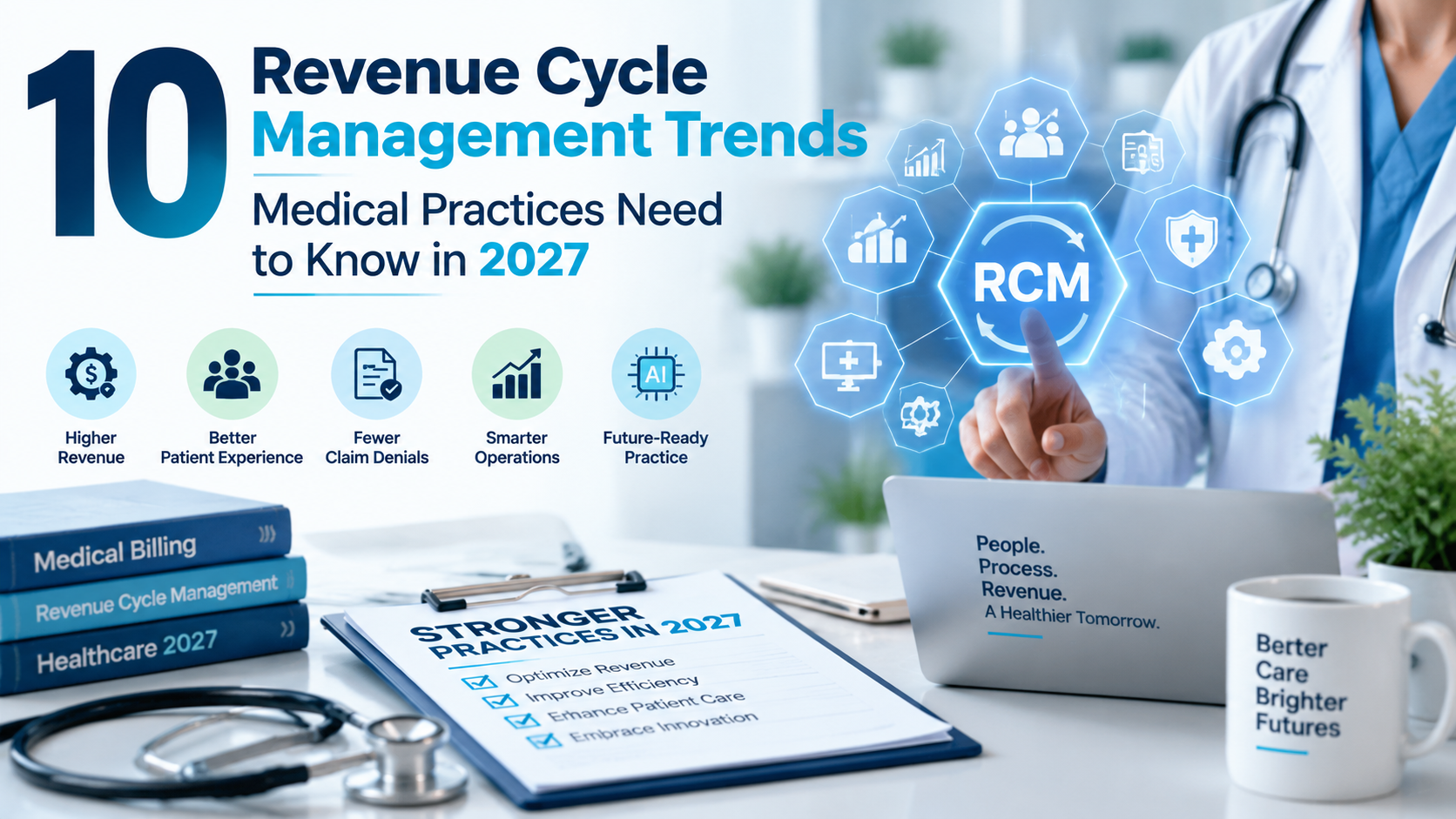
It is important for medical practices to be aware of the following 10 revenue cycle management (RCM) trends.
- Advancements in artificial intelligence, automation and other technology will change the revenue cycle.
- Pre-bill claim review will gain more widespread adoption.
- The rate of claim denials will decline.
- A shift to value-based care will continue.
- The adoption of outsourced revenue-cycle activities will grow.
- Cybersecurity risks and concerns will increase.
- A focus on patient financial experience will increase.
- The use of cloud-based technology and remote access will increase.
- Data analytics will gain importance.
- The use of virtual credentialing will gain more industry acceptance
Denial Management Is Moving Towards Anticipation
Many organizations are moving away from reactive denial management.
Traditional denial management focuses on understanding why an individual claim was denied, and generally takes the following form:
‘Why was claim X denied?’
Anticipatory denial management focuses on systemic and long-term process improvements to mitigate claim denial. This management style takes the following form:
‘Why are claims generally denied within our organization?’
Payers Introduce More Variation into the System
There can be numerous variations in insurance requirements, including:
- The insurance plan
- The payer
- The state
- The type of service
- The provider
- The patient
Different payers may also require prior authorization, and remove or change their requirements for authorization.
Because of this variability, a number of different payer rules need to be continuously monitored by billing staff.
Verifying Patient Eligibility Remains Important
There are a number of issues which may arise with an insurance plan prior to the insurance plan covering a provided service. For example, the insurance plan may deny eligibility for service, cause the billing of a claim to be directed to the provider rather than the payer, or result in the provider not being able to collect insurance reimbursement.
Real time or prompt eligibility checks may help prevent provision of an insured service and the issues associated with insurance eligibility.
The services of Doctor’s Office Solutions assist with the verification of insurance benefits.
Integration of Technology into Medical Coding will Continue
Because of the changing nature of technology and the integration of new, artificial intelligence and automated systems, there will always be a place within the healthcare industry and the revenue cycle for human coders.
The true judgment of a human coder will always be required.
More Data in RCM
Medical practices are getting better access to revenue cycle data.
There are many new resources and tools that allow practices to gauge how their revenue cycle is functioning. More practices are using these tools to better understand their revenue cycle and find opportunities for improvement.
Patient Financial Experience is Critical
The financial aspect of the revenue cycle, and particularly medical billing, has traditionally focused on interactions with payers. However, as patients are responsible for an increasing portion of their health care costs, practices must develop billing processes which adequately address patient financial responsibility and do so in a clear and effective manner.
Part of providing a positive financial experience for patients involves providing them with clear and concise statements and providing them with information about their financial balance and how to pay their financial balance. Providing patients with this information doesn’t guarantee they will pay their balance, but it can reduce the overall number of collection calls which need to be made.
It is critical to provide patients with timely and appropriate financial communications.
Outsourcing the Revenue Cycle Continues
Many healthcare organizations are partnering with other organizations to perform functions within the revenue cycle.
These partnerships can allow organizations to improve functions of the revenue cycle that are traditionally difficult and time consuming.
Aging Receivables is More Important
Aging receivables has traditionally been important to the revenue cycle; however, the focus has been more on the payer side of the revenue cycle. As payers focus more on the patient side of the revenue cycle, aging receivables will continue to be important. The focus will be on following up with patients to ensure receivables are collected in a timely manner.
To gain a better understanding of revenue cycle management, practice leaders should consider the following types of questions:
- Which payers result in the most denials?
- Which services generate the most A/R?
- Which practitioners’ billing behaviors are atypical?
- Which denial codes are predominant?
- What is the average claim submission time?
- Which accounts are require the most amount of follow-up?
When problems occur in the revenue cycle of a practice, the following types of questions can help identify the source of the problem.
The aforementioned questions help practices better understand cash flow, collections, and denials. The central challenge for all of these questions is increased visibility into the revenue cycle of the practice.
Although technology plays a major role in providing visibility to the aforementioned questions, practice leaders should consider the role and the integration of people, process and technology.
What will medical practices be focused on in 2027?
Most practices should be able to invest the time to better understand their current state of their revenue cycle.
Our Place in Revolutionary RCM
Doctor’s Office Solutions provides a myriad of services to assist healthcare entities in streamlining their revenue cycles.
These services include:
Revenue cycle challenges of a practice can divert staff from their core business of patient care and practice management.
This is the philosophy behind most of the services offered by Doctor’s Office Solutions.
Denied claims remain a revenue cycle challenge for most practices.
This is why Doctor’s Office Solutions focuses a greater part of its Denial Management services on upfront claim resolve-to-reimburse activities.
Other denial management activities are covered in the RCM services.
A right mix of all the Denial Management and Revenue Cycle Management services is the way to go for most practices.
Frequently Asked Questions
What will distinguish RCM in 2027?
AI and other automation technologies will enable denial prevention. Coding will be facilitated by technological advances. The management of the A/R will be outsourced. Other new focuses will include payer eligibility, coding and denial management.
Will RCM practices employ AI and automation?
Practices will use AI and related technologies for claim editing, denial prevention and management, and automation of repetitive workflows.
Are RCM denials preventable?
Although denials may be preventable, they occur. Identifying and addressing the reasons for denials will streamline revenue cycle activities.
Is offshoring the revenue cycle increasing?
Yes. Practices are increasingly outsourcing their revenue cycle management functions.
How should small practices prioritize revenue cycle management?
Practices should prioritize revenue cycle management activities by focusing first on claim and coding accuracy, A/R collections and denials and eligibility. Claim editing should also be prioritized.
Conclusion
There are multiple opportunities to ensure that the focus of the practice remains on healthcare delivery.
Automation and AI have begun to disrupt traditional revenue cycle management in various ways, i.e. more aggressive denial management. Elsewhere payer requirements and the complexity of payer rules systems remain. As a result, more and more practices are evaluating the financial performance of their practice as they would their A/R.
The fundamentals, however, have not changed.
Practices evaluating their billing operations must ensure they have the right people and processes to verify patient eligibility and medical coding. More importantly they must be able to ensure clean claims and implement efficient systems to manage follow-up and denial management.
When medical practices engage in revenue cycle management self-assessment in 2027 they should attempt to reduce unnecessary administrative work, increase transparency and improve their systems by integrating people, process and technology.
DOS can help medical practices with various aspects of revenue cycle management, including medical billing, medical coding, denial management, benefit verification and other related services.